
Why Your Planner Stopped Working After 3 Days (It's Not Your Fault)
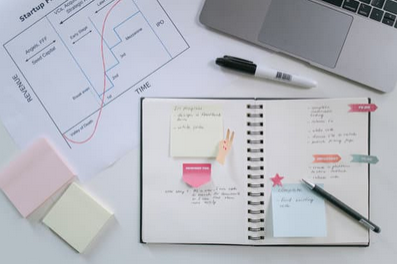
My closet has six planners in it. A bullet journal I set up with color-coded tabs. A spiral notebook from a 'fresh start' in January. A Passion Planner, still in plastic. And my personal favorite: a $47 leather-bound thing I used for exactly one week before it became a coaster.
If you've been there, you know the cycle. Buy the planner. Set it up beautifully. Use it diligently... for about three to five days. Then life happens, you miss a day, the perfect system feels tainted, and it quietly gets moved to the desk drawer.
Here's what the planner industry doesn't want you to know: the problem was never you.
The App Graveyard Is Real, and It's By Design
The average person downloads a new productivity app, uses it for less than two weeks, then abandons it — often feeling worse about themselves than before they started (Baumeister & Tierney, 1998, Ego Depletion research).
We now have more organizational tools available than at any point in human history. And we're more disorganized than ever.
Here's why: tools without systems create the illusion of progress without the substance of it. Buying a planner feels like getting organized. Downloading Notion feels like building a second brain. Setting up a new app feels like forward motion. But the feeling and the function are two completely different things.
A 2021 review of cognitive load research in Frontiers in Psychology found that adding tools without guidance increases cognitive load rather than reducing it. Each new system requires mental bandwidth to learn, maintain, and remember to use — which is the opposite of why you bought it.
The Container Store Doesn't Sell Organization
Here's the sacred cow I'm going to slaughter: buying organizational products does not make you organized.
Disorganization isn't caused by a lack of storage bins. Research on home organization consistently shows that disorganization is driven by the absence of maintenance systems — not the absence of containers (PricewaterhouseCoopers document management research; Harris Interactive survey data). You can have 40 labeled bins and still spend 20 minutes looking for your kid's birth certificate.
The $4.36 billion home storage industry (yes, that's real) is built on a beautiful lie: that the right product will finally solve the chaos. It won't. Products are inert. They do nothing on their own. And when they don't work, you blame yourself instead of the product.
I spent years buying systems. I needed to build one.
What Actually Works: The System Behind the Tool
The research on habit formation and behavioral change is clear: tools stick when they're embedded in systems with accountability, feedback, and a human element (Clear, 2018; Baumeister, 2000).
That's why Weight Watchers outperforms every diet app for long-term results — not because their tracking is better, but because the human accountability component changes the behavioral equation entirely.
Your planner didn't fail because you're undisciplined. It failed because:
Nobody helped you set it up in a way that matched how your brain actually works
There was no accountability when you skipped a day
It only solved one part of your system (scheduling) while your documents, finances, and home tasks still lived in different places
The moment it felt imperfect, there was no one to help you restart
What a Real Command Center Looks Like
You don't need 12 tools. You need one trusted hub that holds your to-do lists, your budget, your important documents, and your home maintenance schedule — and a real human who helps you build the habit of actually using it.
The difference between "another app I'll abandon" and "a system that runs my life" is guidance and accountability. That's not a weakness. That's how humans work. Even the most productive people on earth use coaches, assistants, and accountability partners.
Your chaotic Tuesday morning isn't a productivity problem. It's an infrastructure problem — and infrastructure can be fixed.
Stop buying planners. Start building a system.
lifeALLY combines a comprehensive life command center app with real human coaching — so you don't just have the tool, you actually learn to use it and keep using it.
RESEARCH CITATIONS
Baumeister, R.F., Bratslavsky, E., Muraven, M., & Tice, D.M. (1998). Ego Depletion: Is the Active Self a Limited Resource? Journal of Personality and Social Psychology, 74(5), 1252–1265.
Reich-Stiebert, N., Froehlich, L., & Voltmer, J.B. (2023). Gendered Mental Labor: A Systematic Literature Review on the Cognitive Dimension of Unpaid Work. Frontiers in Psychology. https://pmc.ncbi.nlm.nih.gov/articles/PMC10148620/
PricewaterhouseCoopers. Document Management Research: The average office spends $120 in labor searching for each misfiled document and loses 1 in 20 documents entirely.
Clear, J. (2018). Atomic Habits. Penguin Books. [Referenced for habit formation and system design principles]
Frequently Asked Questions
Why do I keep buying planners and never using them?
You keep buying planners because buying a planner feels like getting organized — and that feeling is real, even if temporary. The problem isn't your discipline. It's that planners are products, not systems. A planner can only hold your schedule. It can't hold your budget, your important documents, your home maintenance tasks, or your financial deadlines. When life is scattered across multiple areas and your planner only addresses one of them, the chaos wins — every time. The fix isn't a better planner. It's a complete system that covers all areas of your life, built with guidance so it actually sticks.
Why do productivity apps stop working after a few weeks?
Productivity apps stop working because they add to your cognitive load without reducing it. Every new app requires mental bandwidth to learn, maintain, and remember to use. Research on cognitive load shows that adding tools without guidance increases mental effort rather than reducing it — which is the opposite of why you downloaded the app. Apps also fail because they're built for general use, not your specific life. Without someone helping you set it up to match how your brain works, and without accountability when you fall off, the app becomes another item on your guilt list.
Is disorganization a personality trait or a systems problem?
Disorganization is a systems problem, not a personality trait. Research on home organization consistently shows that disorganization is caused by the absence of maintenance systems — not the absence of storage products, discipline, or intelligence. Most people were simply never taught how to build a functioning life organization system. If you've tried and failed to stay organized, it doesn't mean you're "not an organized person." It means you haven't yet had the right structure and support to build habits that last.
Why doesn't buying more storage bins fix clutter and disorganization?
Buying storage bins addresses the symptom, not the cause. The $4.36 billion home storage industry is built on the idea that the right container will solve your chaos — but research shows that 80% of household clutter is caused by disorganization, not lack of space. You can have 40 labeled bins and still spend 20 minutes looking for your child's birth certificate, because bins don't create maintenance routines. Organization requires a system: a set of habits and structures that keep things in their designated places over time. Products are inert. Without a system behind them, they eventually become part of the clutter.
What's the difference between a productivity tool and a life organization system?
A productivity tool helps you do specific tasks more efficiently — track your to-dos, manage your calendar, take notes. A life organization system covers your entire life: your budget, your documents, your home maintenance schedule, your weekly tasks, and your long-term planning — all in one trusted place. Most people have tools. Very few have a system. The gap between them is where the late fees, the missed appointments, the frantic document searches, and the Sunday-night anxiety live. A real system also includes the habit of using it consistently — which is where human coaching and accountability make the difference between something you try once and something that actually changes your life.
How do I stop abandoning my organizational systems?
The research on habit formation is clear: systems stick when they include accountability, feedback loops, and human support. This is why Weight Watchers produces better long-term results than any diet app — not because the tracking is better, but because the human element changes the behavioral equation. To stop abandoning your organizational systems: (1) choose one system that covers all areas of your life, not separate tools for each; (2) get help setting it up in a way that matches how you actually think and live; (3) have a person — a coach, an accountability partner — who checks in and helps you restart after a hard week. The restart is what most systems are missing. Life happens. The system that survives it is the one with a human in it.
What should a life organization system include?
A complete life organization system should cover four core areas: a budget and financial system (knowing where your money goes, what bills are due, and where financial documents live); a task management system (one trusted place for every commitment, with real deadlines); a home management system (maintenance schedules, appliance records, contractor contacts, seasonal tasks); and a life file system (organized storage for every important document — insurance, medical records, wills, school records, passwords — findable in under 60 seconds). Most people manage one or two of these. The chaos lives in the gaps between them.
Why do I feel guilty when I stop using an organizational tool?
The guilt is a natural response to a system design flaw — not a character flaw. Organizational tools are marketed as solutions. When they don't work, there's no feedback loop that says "the tool was wrong for you" — so your brain defaults to "I was wrong." The productivity industry profits from this guilt cycle: you feel bad, you buy the next planner, you feel temporarily hopeful, the cycle repeats. The reframe that actually helps: the tool didn't fail because of you. It failed because it was incomplete — missing guidance, accountability, and coverage of your whole life. Guilt is the signal that you needed more support, not more willpower.
